
Exchanging money in Vietnam in 2026: why the gold shop can now get you fined
Oct 1, 2026 · 5 min read
By Marco, living between Hanoi and Ho Chi Minh City for the past six years
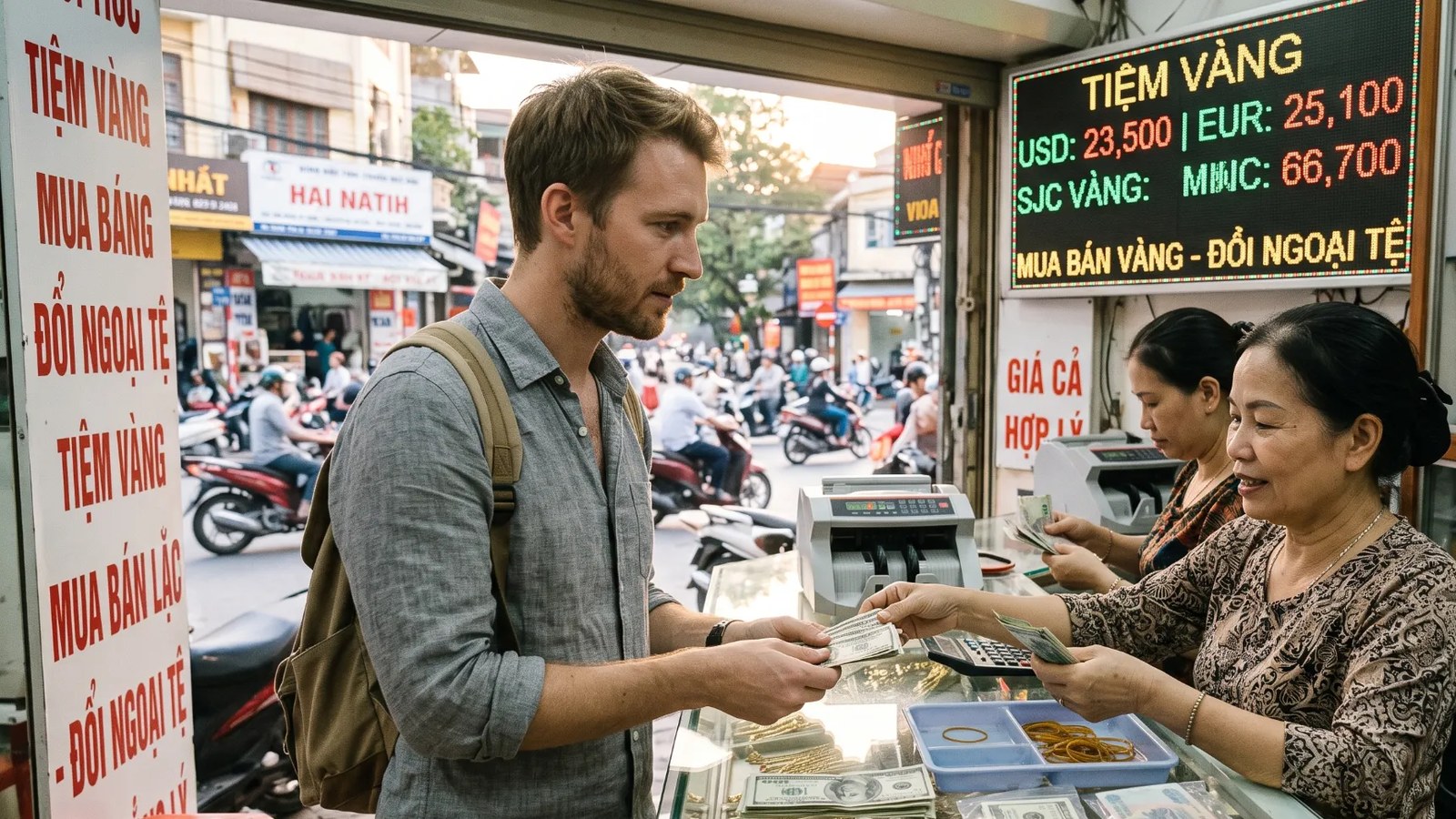
Since February 9, 2026, changing money at an unlicensed gold shop in Vietnam can get you fined, not just the shop. The rule is Decree 340/2025/ND-CP, and it covers anyone who buys or sells foreign currency outside an authorized bank or exchange agent.
That's a problem, because most "where to exchange money in Vietnam" guides still say the same thing they've said for a decade: skip the bank, go to the gold shop, get a better rate. Here's what changed, how much risk you're actually taking, and where to change money legally.
What changed in February 2026
Decree 340/2025 sets new penalties for buying or selling foreign currency at an unauthorized place. The penalty for the customer depends on how much you exchange:
- Under $1,000: a warning
- $1,000 to under $10,000: a fine of 10–20M VND (about $380–760)
- $10,000 to under $100,000: a fine of 20–30M VND (about $760–1,150)
- $100,000 or more: a fine of 80–100M VND (about $3,050–3,800)
USD figures use the late-September 2026 rate of about 26,170 VND to $1 (Vietcombank, via Vietnam.vn).
The shop gets double the fine you do (LuatVietnam). Authorities can also confiscate the money involved in the exchange.
A warning sounds harmless. But it's an official record, and a repeat offence moves you into the fine bracket even under $1,000.
Do the police actually enforce this?
Rarely against tourists, but it does happen. The case every Vietnamese reader remembers is from Can Tho. In 2018, a local man was fined 90M VND (about $3,900 then) for changing a single $100 bill at a jewelry shop. The fine was cancelled after a public outcry, but he still lost the money he got for the bill. The shop owner was fined 180M VND.
That was under the old rules. Today, a first-time $100 exchange gets a warning rather than a fine. The more visible change in 2026 is on the shop side. Hà Tâm, the gold shop near Ben Thanh Market that tourists used for over 20 years, was reported shut in late April 2026. No official reason has been given.
The honest summary: if you change $200 at an unlicensed shop, you probably won't get caught. But you're taking a legal risk to save a few dollars. And if a raid happens while you're at the counter, your passport and your cash are both on the table.
Not every gold shop is illegal
Some gold shops are licensed exchange agents, authorized by a bank. They're legal, and you can use them.
A licensed agent displays a sign that reads "Đại lý thu đổi ngoại tệ" (foreign currency exchange agent). Before you hand over cash, check for:
- The sign and a license naming the bank that authorized it
- A posted rate board with today's buy rates
- A receipt for your exchange
Licensed agents can only buy foreign currency from you. You hand over dollars or euros, you get dong. They can't sell you dollars back. If a shop has no sign, no license, and no receipt, walk on.
Where to exchange money in Vietnam legally
You have 4 legal options. Here's how they compare:
- Banks: Vietcombank, BIDV, and other major banks give a fair rate. Bring your passport. Most branches keep office hours and close on Sundays.
- Licensed exchange agents: Often close to the bank rate, and open longer hours. Check the sign first.
- Airport counters: Legal and convenient, but the rate is worse. Change only enough for your first taxi and meal.
- ATMs: Legal, but fees add up fast on a foreign card. Our guide to avoiding ATM fees in Vietnam covers which banks charge less.
Bring clean, undamaged $50 and $100 bills. Torn or marked notes get a worse rate or get refused.
Is the gold shop rate worth the risk?
No. The gold shop edge is real, but it's small. On a typical day, a gold shop might pay about 1.5% more than a bank (Vietnam Tourism).
On $300, that's about 120,000 VND, or roughly $4.60. That's 1 bowl of pho in a tourist area. It's not worth a warning on your record, and it's nowhere near worth a fine.
Changing leftover dong back is harder
Plan to spend your dong. Changing it back to dollars is much harder than changing into it.
Licensed agents can't sell you foreign currency. Banks often ask for documents explaining why you need it. The reliable option is the exchange counter in the departure area of an international airport, after passport control. The rate there is poor, so don't overbuy dong in the first place.
The simplest fix: need less cash
Most of the time, you don't need a stack of dong at all. Most cafés, restaurants, convenience stores, and street food stalls in Hanoi and Ho Chi Minh City now have a VietQR code on the counter. Locals scan it and pay.
PayMoji is a travel wallet for Southeast Asia that lets you pay those same QR codes in Vietnam and the Philippines, with no local bank account needed. You top up with Apple Pay, Google Pay, or your card before you fly, and see the exchange rate before you pay. No exchange counter, no gold shop question.
Keep a small amount of cash for rural markets, motorbike taxis, and the occasional vendor without a QR code. For the rest of your trip, our guide on how to pay in Vietnam without a local bank account walks through the full setup.
One more cash rule: if you arrive with more than $5,000 in foreign cash, or more than 15M VND, you must declare it at customs.
Frequently asked questions
Is it illegal to exchange money at a gold shop in Vietnam?
It's illegal at an unlicensed gold shop. Since February 9, 2026, customers can get a warning or a fine of up to 100M VND, depending on the amount. Gold shops licensed as exchange agents are legal and display a "Đại lý thu đổi ngoại tệ" sign.
Will a tourist really get fined for changing $100?
Under the 2026 rules, a first exchange under $1,000 gets a warning, not a fine. Repeat offences and larger amounts can be fined, and the money involved can be confiscated.
Where is the best place to exchange money in Vietnam?
A bank or a licensed exchange agent in the city. Both give rates close to each other. Airport counters are legal but cost more, so change only what you need for day 1.
Can I change Vietnamese dong back to dollars?
Yes, but it's harder. The most reliable option is the exchange counter in the departure area of an international airport. Spend your dong before you leave where you can.
Do I need cash in Vietnam at all?
A little. QR payments cover most cafés, restaurants, and shops in the cities. Carry about $20–30 in dong for markets, rural areas, and vendors without a QR code.